Thursday, June 24, 2010

Seafaring in Silicon Valley

There's lots to be said for working on an oil tanker. You get to see more of the world than most people, for a start. For maritime work the pay's really good and there's the opportunity for nice annual bonuses. The stability (both figuratively and literally) is a big plus no doubt, and the work's predictable too: you wake up each morning and for the most part know what you're going to be doing that day.

In fact when you think about it, the predictability of work on an oil tanker is there at a macro level as well. You probably have a pretty good sense for what you'll be doing in six months' time, for instance. After that it'll probably depend on whether you get that promotion to senior oil-tankerer. Beyond that, who knows? Possibly if the VP of oil-tankering kicks off that reorg then a Director spot will open up. It's good to always have a sense of what's next, and you pretty much know that your tanker's going to be around for a good while to come.

And moreover, oil tankers are uniquely huge and impressive pieces of machinery; the pinnacle of modern seafaring art at scale. You could spend many happy years working on an oil tanker—getting to know every nook and cranny, learning every detail of its immense operation. Developing a deep expertise in something can be very fulfilling, and working on an oil tanker can provide just that opportunity.

From what I hear, there's plenty of general flexibility in the work. The vacation allowance is great, the benefits generous, and you know what? Recent oily events notwithstanding, it's actually pretty difficult to mess up big-time and lose it all. After all, an oil tanker is such an unimaginably expensive concern that there's an array of battle-tested procedures, best practices and safety technology to practically eliminate the chances of human error causing catastrophe.

What's not to love?

On an ocean-faring yacht, by comparison, the salary isn't as good and the perks aren't quite so lavish. You also feel the choppy waters, and on occasion sea-sickness can strike quite severely. Storms which would barely be noticeable on a tanker are life-threatening on a smaller vessel. Passion and guts are required in no small measure, and the danger is real: more than a few yachts have been lost at sea entirely.

The work's nowhere near as predictable, either. It really requires a fluid state of mind where you wake up each morning prepared to keep the vessel afloat, come what may. On a good day you'll get to pay attention to the trim of the sails or how best the whole crew can work together. On a bad one it'll be all you can do to keep the ship above water and, you hope, heading in the right direction.

You've got to be pretty careful working on a yacht, too. The guardrails aren't always where you'd hope they might be and it's all too easy to switch that bilge pump into reverse by accident. Stay alert! Procedural lore is yet to be established, and in its absence there's a lot of trust placed in individuals to figure out the right thing to do (and establish said lore along the way). If you doubt your ability to improvise well, don't join the yachting crew.

And don't even start about the "career path" on a yacht. Senior yachtsperson? Director of yachting? Is there a Yacht General Manager about to appoint a chief of staff? Not so much. Fancy titles, job levels and promotion cycles are something which will come once the next storm has passed and this thing has stopped taking on water.

But you, yes you, can help with that—and it's exciting. There's an exhilaration and a vitality which you just can't get elsewhere. Every day is different, and the sense of adventure is absolutely unbeatable. It's raw and exhausting, but hearty and uniquely gratifying too. The decisions you make each day will affect the course of the journey taken by the crew as a whole, and that brings its own sense of reward. What's more, on a yacht there's a chance of discovering new lands to which an oil tanker could never get close.

No doubt there are an infinity of unknowns when exploring on a yacht. Where will you be in six months? Will your supplies last? Should you be concerned about those clouds? Is the boat really supposed to lean like that? If these thoughts make you long for terra firma then perhaps the life's not for you.

On the other hand if you can roll with it, set sail, and choose your own adventure then you're in for a great ride. Certainly you'll get drenched on the way, but the wind and the sun will dry you off and you'll feel great.


Monday, May 31, 2010

Team versus Idea

A friend of mine has a job offer from a small technology startup. They just got funding and he's considering joining the ten or so other folks working there. His worry: what if their main product doesn't work out? What if it's a market failure? What then? Is he stuck looking for work again?

With the right team the answer is: no. The ideas will evolve quickly, and the team will land on something which is really going to work. It needn't look at all like the product they're building today, and that's OK. In fact a slavish adherence to the original plan, in the face of market ambivalence, is an extremely common failure mode for startups.

There are a number of great examples of adaptability from technology startup history. Here are two.

Exhibit A: Twitter. Here's how TechCrunch reported the debut of "Twttr" back in summer 2006.

...the fact that this is coming from Odeo makes me wonder—what is this company doing to make their core offering compelling? How do their shareholders feel about side projects like Twttr when their primary product line is, besides the excellent design, a total snoozer?
The point being that Twttr at the time was indeed a side project of Odeo—a company which was doing something completely different. Three months later Obvious Corporation (founded by Ev and Biz and Jack, now familiar as the inventors of Twitter) acquired Odeo, as well as the Twttr product, and six months after that Twitter was spun off as its own company. (Disclaimer: I work for Twitter)

Exhibit B: I'll let Cory Doctorow tell the story, as he told it on This Week in Tech last week.

Here’s what I mean by innovative, fast, smart development.

When I was dating the woman who is now my wife, Alice, I was on the board of a company called Ludicorp and they made a little flash game that was really fun. Alice lived in London, I lived in San Francisco and we had this long-distance relationship, and one day the Founder of Ludicorp came over to my place in San Francisco and said how’s it going with Alice? And I said you know, it’s going great and we share these photos of our days as we go through the day, but it’s a pain to do it, and he said, Oh! we’ve got photo sharing coming in the game, we’ll accelerate that feature.

And people really liked it. So they were revving the game a lot, like every 30 minutes, and eventually that feature grew to eclipse the game and they retitled the service Flickr.
And funnily enough you can see the vestige today in Flickr URLs like http://www.flickr.com/guidelines.gne. Originally the .gne stood for "game neverending", the Flash game which was the Flickr precursor.

This is an old concept: the 'A' team with a 'B' idea versus a 'B' team with an 'A' idea. Investors tend to prefer the former. Why? Because there's a good chance they'll improve upon the 'B' idea to make it great—whereas the 'B' team will most likely simply fail to execute on their 'A' idea.

I'm excited for my friend. I happen to think that the startup in question has a great team and will find success even if it's not based on their current product.

Unrelated: a photo from this weekend:

Serve

Saturday, May 29, 2010

WAT IS LIFE

Astonishing. I found this on Lamebook and felt compelled to post it here.

Shared on Facebook by "Steven", with whom I suspect it would be very interesting to spend some time:

BEEN TRYIN 2 WRITE MY THOUGHTS MORE SO CHCK THIS.

WAT IS LIFE? IS IT JUST THE OPPOSITE OF DETH OR IS IT SUMTHING MORE. WE KNO IT IS ON ALL THINGS LIKE FROGS AND STICKS AND SHIT BUT WHERE DOES THE LIFE GO WHEN THOSE THINGS DIE. I KNO FOR CERTIN THAT WHEN I DIE I AM RIDING WITH FUCKIN JESUS BUT EVEN THAT HAS GOT ME ASKIN QUESTIONS. LIKE WAT R WE GONNA DO FOR ETERNITY. IS ME AN JESUS JUST GOIN 2 PRETTY MUCH CONSTANTLY FIGHT DEMONS? DO THEY NEVER DIE? WTF R WE SUPPOSED 2 DO IF WE KILL ALL THE DEMONS AND DEVILS AND SHIT AFTER A THOUSAND YEARS. THERES STILL GONNA BE MILLIONS OF YEARS LEFT. MY PAPS USED 2 TELL ME THAT WED BE ROLLIN IN MEDOWS WITH FLOWERS AND SHIT BUT I DO THAT HERE AND IT GETS BORING AFTER LIKE 10 MINETS AND MAYBE IF I TRIED REALLY REALLY FUCKIN HARD I COULD ROLL ROUND IN A GRASSY FIELD FOR LIKE MAYBE 30 OR 40 MINETS BUT HOW THE FUCK AM I GONNA DO THAT SHIT FOR MILLIONS OF FUCKIN YEARS. SO I GUESS I HAVE 2 END THIS DA SAME WAY AS I STARTED WAT IS LIFE.

The mind boggles.

Wednesday, May 26, 2010

Maker Faire

According to Wikipedia, Maker Faire is an event created by Make Magazine to "celebrate arts, crafts, engineering, science projects and the Do-It-Yourself (DIY) mindset". According to me, it's a festival of creativity. Every year I've been there I've been blown away by the ingenuity, the friendliness, the innovation, the enthusiasm, and—especially the last couple of years with it attracting a more mainstream crowd—the excitement of hundreds of wide-eyed kids. It's enormously energizing.

There are homemade human-powered vehicles, cars modified to get 100mpg+, science experiments, flames and kinetics, lasers, Tesla coils, soldering workshops and surface-mounting classes. There's a life-sized mousetrap setup, neon light glass-blowing, wooden computers, high-speed photography, metalworking, and much more. It's a unique and phenomenal gathering of geeks, artists, and imaginative souls.

Witness "Deus Ex Machina, a large-scale swing with a computer controlled interactive water plane that makes shapes and text. Using water released from solenoid valves, a plane is created in front of the swing rider. A sensor tells the machine the rider's position as shapes and messages descend in the rider's path". Amazingly clever (see the video) and huge fun for kids:

Swing

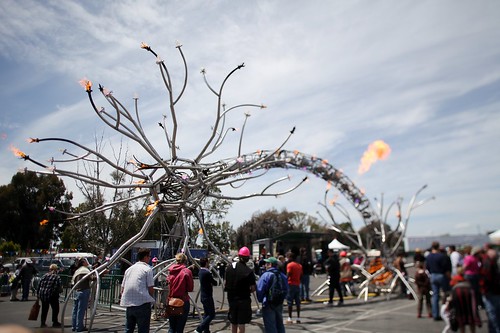
There was also The Ant, an enormous interactive installation spewing fire out of its arched back. Eight pads at ground level, amenable to pounding by adrenalized children, controlled fiery emissions from eight separate flame-throwers mounted high above:

The Ant

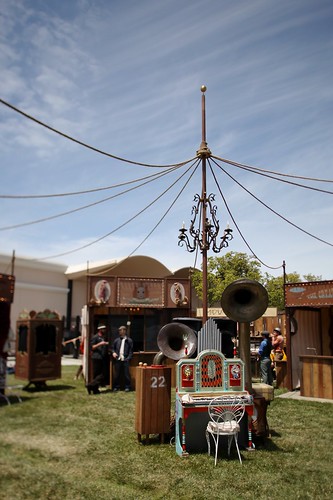
Check out the crazy piano, too. I'm not even quite sure what this is or how it related to the central Maypole but it was pretty cool:

Steampunk Piano

Steampunk is quite a "thing" at Maker Faire and it prompted me to do some research on what it is and where it's from. Short story, my interpretation: an alternate future projected forward from the pre-electronic mid-1800s. Intricate and clever gadgets abound, but powered by springs or steam. If nothing else it reminds you of the pointlessness of projecting a century forward from where you are. Nigh impossible to predict the upcoming technological revolutions.

Steampunk

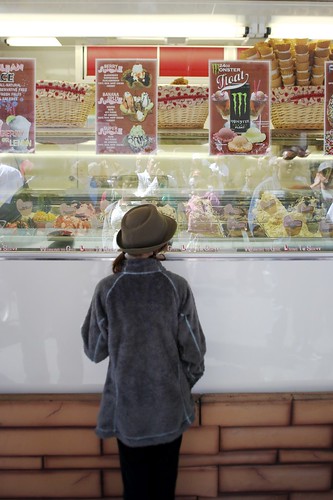
Like many a faire, there's ice cream:

Kid at Ice Cream Store

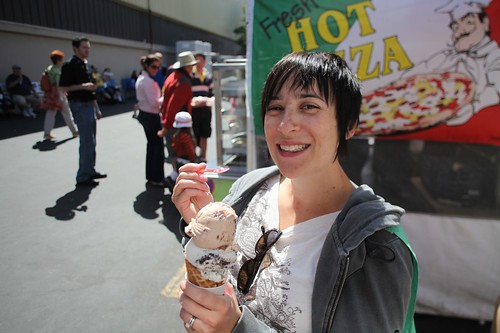
Wendy enjoyed this aspect too.

Wendy Eats

Full set of photos on Flickr.

Thursday, May 20, 2010

Andrea's Birthday

Andrea's a dear dear friend and we went to Oakland for her birthday. OAK-LAND!

She has a roof garden above her apartment and we hung out in the sunshine. At 4pm you could see the San Francisco skyline across the Bay. By 6pm the city was covered in fog but the deck was warm and sunny and glorious.

Birthday cupcakes:

Cupcakes
Me:
Isaac
Andrea:
Andrea

Sunday, May 16, 2010

Afternoon Ballgame

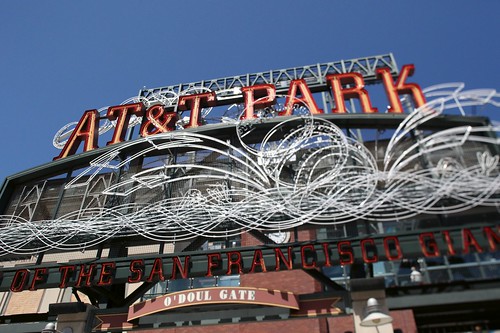
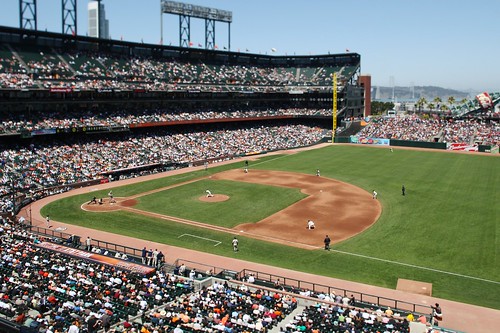
My team at work went to an afternoon baseball game this week. Courtesy of a generous donor, we had a box for the midday game between the San Francisco Giants and the San Diego Padres at AT&T Park.

AT&T Park

As an Englishman who didn't grow up with the sport, and recent drug scandals notwithstanding, I have a strong feeling for the romance of the game. Fifty years older than American football (yes, that's what Wikipedia calls it), and the subject of such wonderfully schmaltzy movies as Field Of Dreams, baseball seems somehow quintessentially American like no other sport.

An informal survey reveals answers to the question "who's the most famous player of all time?" for various sports:

Spot the outlier? The guy who was born 50 years before any of the others? That's because baseball is special. Its history lends it a definite eminence—or at least in the eyes of this immigrant.

Nonetheless, my own history with baseball doesn't go quite so deep. I went to a Yankees game in New York in 1998, maybe a dozen Rockies games while living in Denver 2003–2005, but until this week I'd never been to see the Giants play in San Francisco. Thursday's work outing was a chance to see the AT&T Park at its best: a glorious sunny day and a close game.

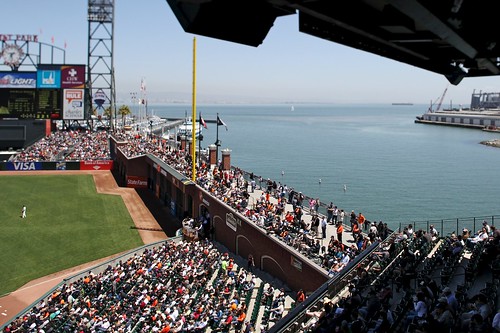
The field itself is great, too. Lovely view of the San Francisco Bay stretching out to Oakland:

Bay
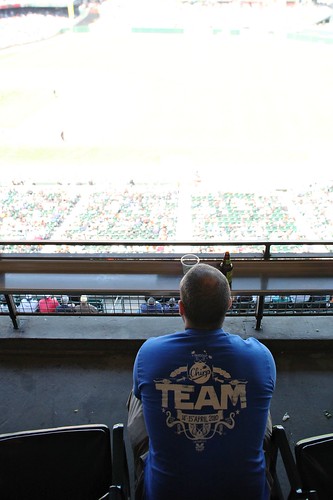
and the view of the action was fantastic, with the Bay Bridge visible top-right:
Pitch

The Giants lost 0–1, but what a lovely way to spend a weekday afternoon.

Mark

Full set of photos on Flickr.

Monday, May 10, 2010

Bernal Heights

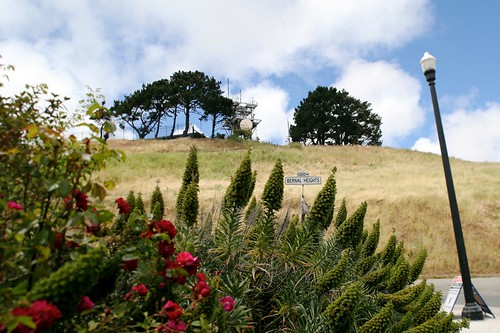
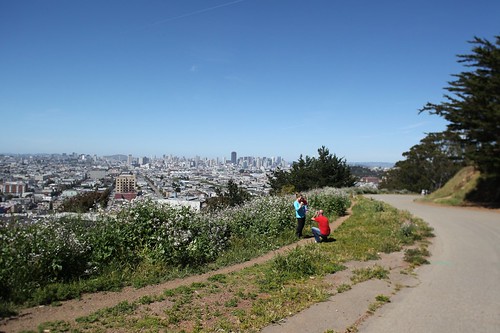
Following on from my last post about Bernal being a photographic inspiration, here's a picture from our walk yesterday:

Bernal Heights

I mean seriously, how could you not love these wilds being on your doorstep?

Sunday, May 09, 2010

Walking up Bernal

Saturdays and Sundays Wendy and I like to walk up and over Bernal, rambling over the peak and through the surrounding neighborhoods. The top of the hill is rich and wild with great views of the city; on clear days you can see the Golden Gate Bridge and the Bay Bridge from a single vantage point.

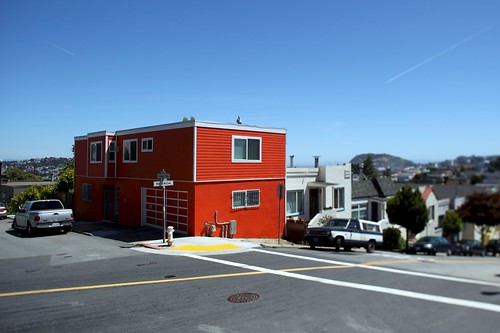
The area round the edge of the park is threaded with tangled streets, often winding up vertiginous slopes (it's a little-known fact that San Francisco's steepest street section is on Bernal).

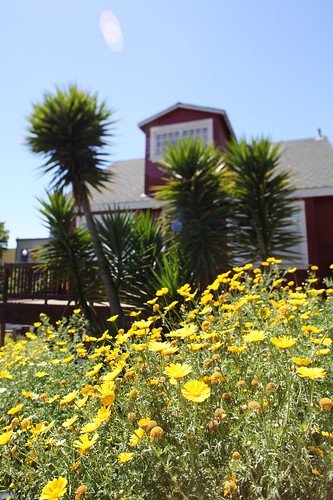
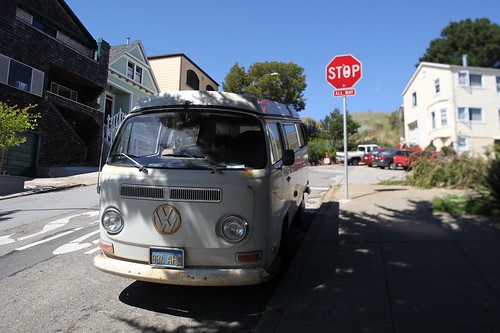
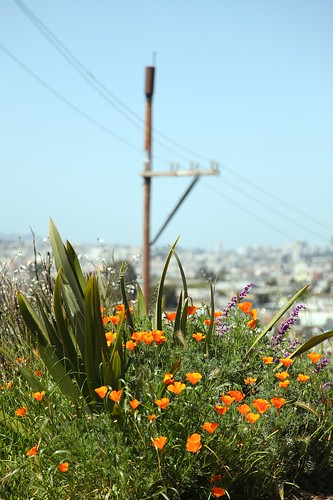
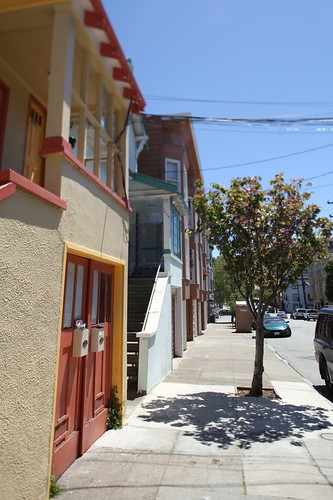
It's a constantphotographicinspiration, even after five years of living here.

Powhattan & Nevada
Flowers
VW Van
Flowers
Gate
Alabama Street
Photo Opp

Saturday, May 08, 2010

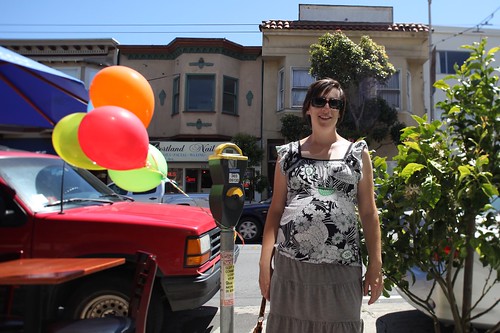
Wendy and Balloons

Wendy in Bernal sunshine. Taken last week.

Wendy and Balloons

Wednesday, May 05, 2010

Google Replay

Sad but true: in 3½ years at Google I never compiled a protocol buffer. I also never contributed directly to the launch of a consumer product on google.com. Making up for lost time at Twitter, though, in my first few weeks there I've done both.

Enter Google Replay.

Search for Bieber on Google Replay and it'll show you a chart of the volume of Justin Bieber tweets this month. If you wonder what the spike is on April 10th, you can drill down by clicking on the timeline, and then again, to individual tweets about the JB sketch on SNL. Pretty cool! See also: results for Chirp, the Twitter developer conference.

Puzzler: below is a chart showing tweet volume (from Google Replay) for a two-word search term over the last few months. Notice the pattern of weekends (green) and the anomaly (red). Name the search term.

Screen shot 2010-04-28 at 11.29.11 PM.png

Monday, April 19, 2010

Chirp

Last week I spent a lot of time at Twitter's first ever developer conference, Chirp. What an event!

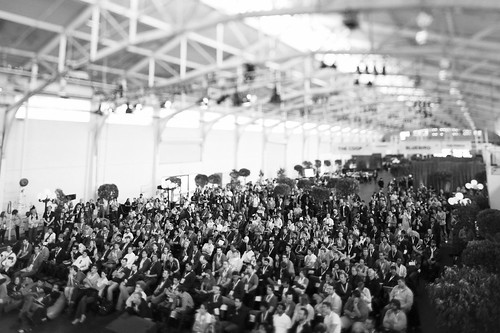
Showcase Crowd

A handful of my favorite photos (full set here):

Monday, April 12, 2010

Learning or Earning, Redux

A friend David provided some valuable feedback on my last post. He gives me a great opportunity to take a small step back and clarify some things. He also sets up the perfect segue into my continued thoughts. Read on.

From David:

Though I've learned a lot from my time working at other leading & famous tech companies, I've probably grown and learned more at Google than the other places... from a technical perspective. On the nontechnical side, I've probably learned more elsewhere. But from a tech perspective, it's absolutely totally worthwhile - as well as fun and productive.
I actually agree wholeheartedly, which makes me think I wasn't clear in my intentions last time. I had a great few years working at Google, had fun and learned a whole lot. I wasn't meaning to bash the place or indicate any regret at having been there (I have none). Quite apart from anything else I met a fantastic set of folks there, David himself amongst them.

It's inevitable, though, working at any one company, that there comes a point beyond which you're no longer becoming skilled in the kinds of things the company does and instead you're developing increasing expertise in the way the company does them.

In the beginning you're learning the principles of computing at scale; in the end you're the guy to whom people go when they need help debugging config files for the proprietary distributed software stack. You start off gaining an understanding of best practice for source control management across ten thousand engineers, and end up with a homegrown library of shells scripts which will only ever work for $COMPANY's system.

Having just changed jobs, I'm experiencing an acute sensitivity to transferrable and non-transferrable skills. The key discovery for me is that the general principle applies beyond the domain of software engineering. If you're developing a talent for getting things done organizationally, try to watch out for the point after which day by day you're getting better and better at getting things done in your company in particular rather than getting things done in general.

I had coffee the other day with a friend who estimated that in her job she spends more time going around getting approvals to do stuff than she spends actually doing stuff. She's amongst the very best where she works at getting approvals for things, but to what extent is that skill fungible in the jobs market? How might one expect her to perform in a new organizational context?

Ultimately this is, of course, only interesting to the extent that you care about the "jobs market" or becoming an attractive commodity within that market. To repeat myself: my facile philosophy on my accidental career is "be in a job where you're either earning big or learning big". The point of these posts, though, is that you should also consider what's actually worth learning.

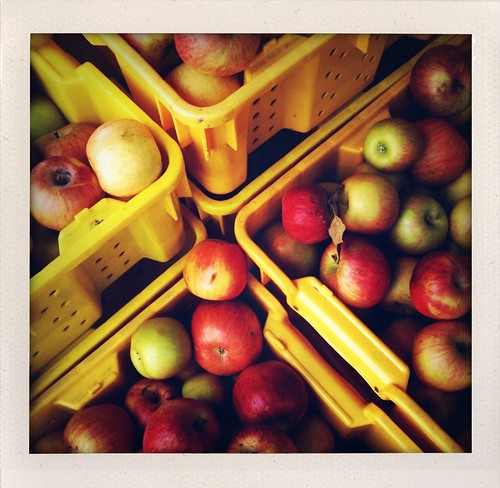
Recent polaroid:

Apples

Wednesday, March 24, 2010

Learning or Earning

Google has a legendary and fearsome proprietary software stack, designed for massive scale. Distributed serving, distributed load balancing, distributed processing, distributed locking, distributed file system, distributed structured storage. Many of the principles are public by now— GFS, Bigtable, Map Reduce, Chubby are some examples—but the Google implementations are most certainly not in the open. Plus there are large horizontal pieces of Google technology which aren't even well-known publicly and about which I can't even write.

It's all enormously clever stuff. Seriously.

And when I joined Google this clever stuff was an impressive competitive advantage. It allowed Google to operate at an unprecedented scale, with huge reliability as well as at lower unit operating cost than competitors. And it still runs like this, and they're still way out front with this technology as far as I can tell.

Over time, though, such an advantage naturally erodes in relative terms. The open source stack grows ever thicker and by now includes pieces of technology like Cassandra, ZooKeeper, HDFS and Pig (and indeed the Hadoop project in general). The principles of huge-scale computing on commodity hardware are being better understood, and the open stack becomes ever-more viable for real-world work.

As the gap between commodity and proprietary narrows, the downsides of a homegrown stack become increasingly palpable. It takes longer to migrate acquired companies to your platform. There's no liquid talent market into which to tap when hiring. Maintaining a custom toolchain becomes burdensome. You risk making your engineers feel like outsiders in the broader tech community—ironically despite the hyper-advanced technology with which they work. Your existing employees may even resist or resent developing skills which aren't marketable elsewhere.

This last point is key. For a long time my facile philosophy on my accidental career was "be in a job where you're either earning big or learning big". Lately, though, I've begun to think a little deeper about the trade-off. It's important not just that one is learning but also what one is learning. On the technical side the argument is clear, I hope (see above). It's recently occurred to me that there's an argument directly parallel from an organizational perspective.

That's for next time.

Here's a polaroid from my commute to Twitter yesterday:

Gate

Tuesday, March 23, 2010

While you wait

I've got two blog posts in draft form waiting to be finished. They're both hard work but I'm glad I'm taking the time.

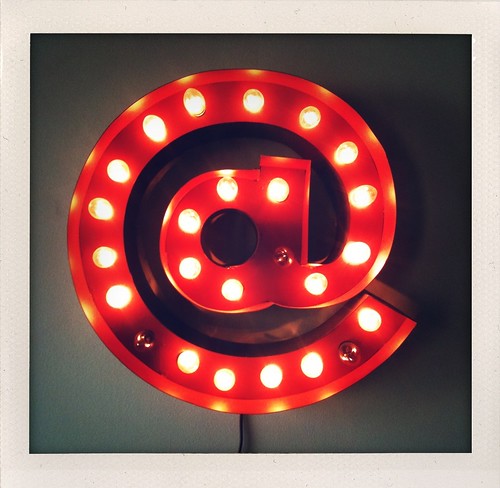
While you wait, here are a few recent polaroids. From the Twitter office:

@
From April and Brad's patio:
Star
From my commute today:
Balloons

Monday, March 15, 2010

Mission and Vision, bis

Apropos of last time, on xpastor.org there's a really great framework for thinking about organizational mechanics and purpose. I know nothing about xpastor but I thought that the neat entity diagram was great and the quote from Sun Tzu solid.

Last night I posted photos of guests from April's wedding. Here's one of my favorites:

Daniel and Leah

Saturday, March 13, 2010

Mission and Vision

I wrote the below a while back as part of building a framework of common purpose in my group at work. At my new job I've found the same thing useful to contextualize the business and the decisions we're making. It helps to have a logically consistent line of thought all the way from the big picture to the quotidian.

A Mission is what an organization is all about; what we do every day, and what we excel at. Think of it as answering the questions "what do we do, for whom, and why?". It defines our role at the highest level and describes the areas which are pre-ordained for us.

A Vision, on the other hand, describes what the future will look like when we achieve our Mission. It's what will happen because we execute so superbly on our Mission. "A PC on every desk", Microsoft's early vision statement, is archetypal.

Traditionally, one's Mission would be derived from one's Vision. Once you've decided what you want the future to look like (the Vision), you pick the Mission which will get you there.

Putting this all in perspective,
  • Vision dictates Mission
  • ...which determines Strategy
  • ...which surfaces Goals
  • ...that frame Objectives
  • ...which in turn drive the Tactics
  • ...to deliver Key Results

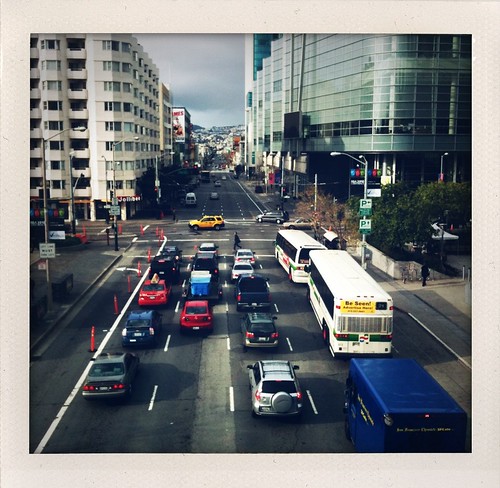
Here's a picture from my commute the other day:

Howard Street

Monday, March 08, 2010

Austin Wedding

A couple of weekends ago Wendy and I flew to Austin to see April and Brad get married. I've posted a set of the wedding on Flickr as well as one of some of Austin we saw.

I'd never been to Austin before but liked the feel of the place. I used to live in Colorado, and Austin had the air of a cross between downtown Boulder and Denver's LoDo. College town, hip crowd, sprawling frontier settlement, ancient creek, huge skies, wide concrete roads, prairie homes, converted brick warehouses, blue city in a red state.

Look at that big sky, clear as can be:

Monroe
Wendy enjoying a chopped beef sandwich, authentic Texas BBQ style:
Happy Wendy
A rural suburban front yard, 2 miles from the Texas Capitol Building:
Front Yard Tree

From the wedding, a few favorites are this one of the bride and groom:

Brad and April 31
and this one of the gorgeous occasion:
Brad and April 17

Sunday, March 07, 2010

Reinventing Collapse

For Christmas, one of the books I got was Reinventing Collapse by Dmitry Orlov. The premise is that the author was "born in Leningrad and immigrated to the United States in the mid seventies". He was "an eyewitness to the Soviet collapse over several extended visits to his Russian homeland between the late eighties and mid-nineties". From the platform of this experience he compares the former Soviet Union and today's United States. Noting similarities and differences between the two—in culture, infrastructure, religion, economy, industry, government, education, housing, and so on—he extrapolates a narrative of the impending collapse of the US via some thoughtful analogies with the fall of the SU.

Dmitry is brilliantly perceptive and wonderfully witty, and Reinventing Collapse is a wickedly cynical book. I had many favorite passages but here's one in particular which I enjoyed:

The Soviet Union had a single, entrenched, systemically corrupt political party, which held a monopoly on power. The US has two entrenched, systemically corrupt political parties, whose positions are often indistinguishable and which together hold a monopoly on power. In either case, there is, or was, a single governing elite, but in the United States it organizes itself into opposing teams to make its stranglehold on power seem more sportsmanlike. It is certainly more sporting to have two capitalist parties go at each other than just having the one communist party to vote for. The things they fight over in public are generally symbolic little tokens of social policy, chosen for ease of public posturing. The Communist party offered just one bitter pill. The two capitalist parties offer a choice of two placebos. The latest innovation is the photo finish election, where each party pre-purchases exactly 50 percent of the vote through largely symmetrical allocation of campaign resources and the result is pulled out of statistical noise, like a rabbit out of a hat. It is a tribute to the intelligence of the American people that so few of them bother to vote.

On a very few occasions the hyperbole was just too much and the propositions arising became farcical or facile. The vast majority of Dmitry's "intentionally provocative thought experiments", though, were fascinating, wise, cogent, intelligent, and delivered with a delightfully dark sense of humor.

Reinventing Collapse is an enjoyable and worthwhile read; I couldn't put it down once I'd started. As one reviewer comments inside the front cover: "be prepared to have your window shoved open and feel the fresh air shake you up".

Saturday, March 06, 2010

Two Truths and a Lie

To recap from last time, two truths and a lie about me:

  1. I went to ballet class as a kid;
  2. I played the piccolo in the school orchestra; and
  3. I was a competitive teenage ping-pong player.

Illustrative of the need for the Salmon protocol, I've had friends guessing the lie on Facebook, FriendFeed, Google Buzz, Twitter, and in the comments here on my blog. I was surprised to find the votes easily consolidated:

  • nobody chose number 1, the ballet classes;
  • one person chose number 2, the piccolo; and
  • everybody else chose number 3, the ping-pong.

Congratulations, then, to my friend Craig for being the only one to pick out my lie about the piccolo. In actual fact I played the flute in the school orchestra. I've been told that's a bit sneaky, but hey—this is the internet. It's the wild west here, folks.

I'm not sure what to make of nobody picking the ballet classes.

Here's the other photo of me which nearly made the cut to be my "Hi, I'm Isaac" photo to accompany my fun facts. Taken by Wendy in Golden Gate Park last summer:

Isaac

Thursday, March 04, 2010

Fun Facts

I'd never come across the concept of "fun facts" before working in Silicon Valley. Here, though, they seem to be the standard way of introducing people. Mainly they come in triples, for example "Everybody, meet Bob. Bob climbed Mount Tahoma last year. Before that he lived for ten years in a shack in North Dakota. He knits his own swimwear".

My last two employers have asked me for fun facts about myself so that they could introduce me, and here comes my new employer asking for the same (I start there on Monday).

So while I think about it here are three fun facts about me:

  1. I first made money from computers when I was 13, earning £10 for a 6502 assembly language program published in Acorn User magazine in the UK;
  2. my wife Wendy and I are expecting our first child in July and are very excited; and
  3. I'm too old for a fixie but I ride one anyway.

Twitter also asked me to supply a photo of myself. I sent this one which Wendy took on Spring Break last year in Lone Pine, CA:

Isaac

Talking to Wendy this evening about fun facts, she introduced me to a variant "two truths and a lie" which I like much better. For completeness, here are two truths and a lie about me:

  1. I went to ballet class as a kid;
  2. I played the piccolo in the school orchestra; and
  3. I was a competitive teenage ping-pong player.

Spot the lie.

Wednesday, February 24, 2010

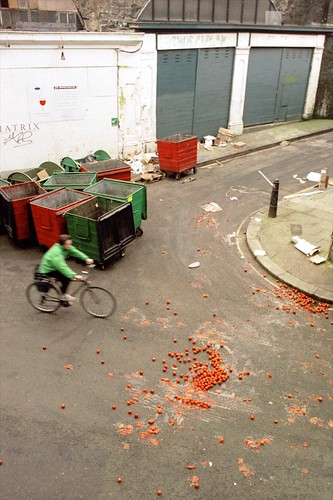
Bike vs Tomatoes

Following on from my last post, this is what the aftermath of a night of wholesale vegetable trading in Borough Market used to look like. I took this from the window of my flat in 1998.

Bike vs Tomatoes

Tuesday, February 23, 2010

Three Windows

Years ago I lived in Borough Market. When I moved there in 1998 it was pretty much an abandoned area of London frozen in time: a little Dickensian enclave. Filthy vegetables were sold wholesale 2am–6am, the corner pub opened 6am–9am to serve the market vendors, but for the other 17 hours each day it was more or less empty apart from shady characters up to no good amongst the deserted stalls and sooty arches.

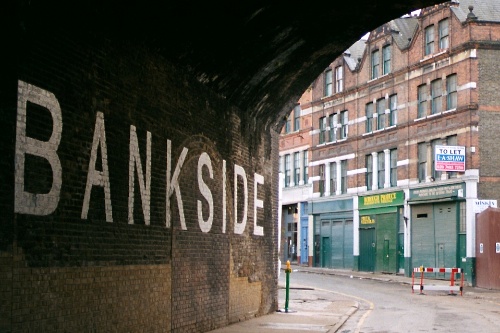
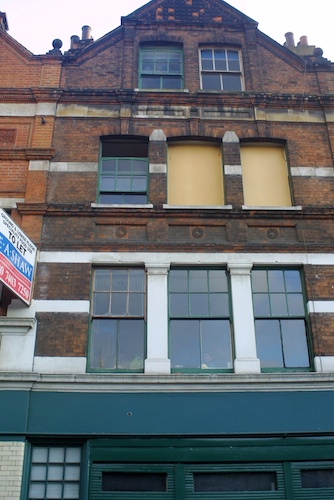
I took the photo below exactly ten years ago today, 23 February 2000. See those three windows on the first row, the second set in from the left? Those looked out from the front of my flat, 11 Stoney Street:

015_22A.jpg
Here are the same three windows a year or so later, in June 2001. I can't remember what was going on at the time with the flat upstairs but boarded-up windows were pretty common in the area.
106-0676_IMG.jpg
And talking of shady characters, you can see the three windows again top-center about a minute into the first scene of Lock, Stock and Two Smoking Barrels. Here's Bacon on the run after the cozzers turn up:
vlcsnap-3057256.png
(The B.J.D. SUPPLIES LTD sign was put up for the filming in 1998 and taken down afterwards)

The whole neighborhood has changed quite a bit now; I visited a couple of weeks ago as I passed through London. These days it's glistening sun-dried tomatoes rather than muddy sprouts, and instead of piles of trash on the corner it's carts offering slivers of imported jamón or nuggets of organic falafel. It's upscale and lavish and epicurean and gastronomic. How incredible that an institution 150 years old (or 700 at a stretch) can transform so dramatically and so suddenly.

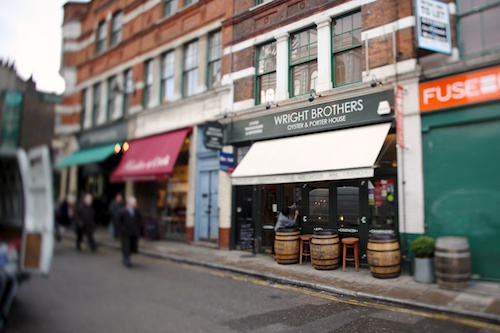
The three windows are still there. The windowless ground floor, however, which used to house my downstairs neighbor (a reclusive artist) in the late 90s, is now a glass-fronted oyster place.

Wright Brothers

For the nostalgic, I've got on Flickr a set of shots of Borough Market in its pre-tapas days.

Thursday, February 18, 2010

Fifteen Minutes

My moment of fame: isaach.com being linked from TechCrunch. You can't but sympathize with the fourth commenter George:

Are you seriously planning on reporting about every little nobody that leaves Google and joins Twitter?

Indeed.

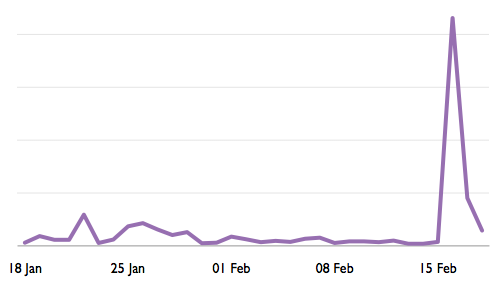
Here's what a Crunching looks like, showing visitors to this site over time:

Screen shot 2010-02-18 at 10.36.41 PM.png

Tuesday, February 16, 2010

Next Stop: Twitter

When I left Google I didn't have any plans in particular apart from taking a "funemployment" break and finding the right next move. At first I wondered how I was going to go about it.

goodjob.png

Ever the good corporate citizen, I figured I'd start off with meetings. I met a lot of people in a lot of coffee shops. There were some who got in contact with me when they heard I'd left Google. There were other people from previous lives and previous companies with whom I was long overdue in catching up. Still other interesting people I managed to hunt down through ruthless LinkedIn-ing.

I had a great time hanging out with people and talking about the business of technology. I signed some NDAs and learned some amazing things. It's actually incredibly exciting how much is going on out there.

After doing a lot of talking and a lot of thinking I made the breakthrough realization that in fact I wasn't looking for a specific role so much as I was looking for a specific environment:

  • a tech company;
  • a transformative product;
  • a kick-ass team;
  • a strong top-down vision; and
  • ideally in San Francisco.
and then it got much easier to narrow down the possibilities. So while I did consider a few especially interesting opportunities outside of SF I mostly stayed local.

From the beginning, Twitter stood out as seriously impressive. Everyone I met there was smart, super-interesting, switched on, and welcoming. I'm a keen user and fan of the product. What's more one of the co-founders mentioned while interviewing me that he wants Twitter to be not just in San Francisco but a part of San Francisco. I love this city and thought that that sentiment was especially cool.

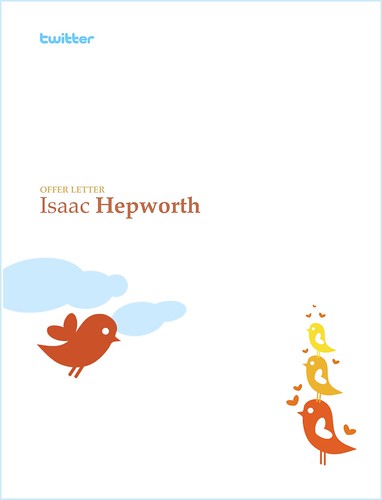
Most of all, though, and as I said on Twitter itself, how could I resist such charming stationery?

Twitter Offer

I'll start next month as a Product Manager and I'm pretty excited. Between now and then I've got a few weeks of funemployment left and lots of thinking to do so I can hit the ground running in my new job. If you've got thoughts or ideas about Twitter, send 'em over.

Thursday, February 11, 2010

More Polaroids

Like I said, I'm a bit obsessed with this iPhone app. Here are a few more shots since last time.

I staged and took this one to make Wendy's birthday card:

Heart
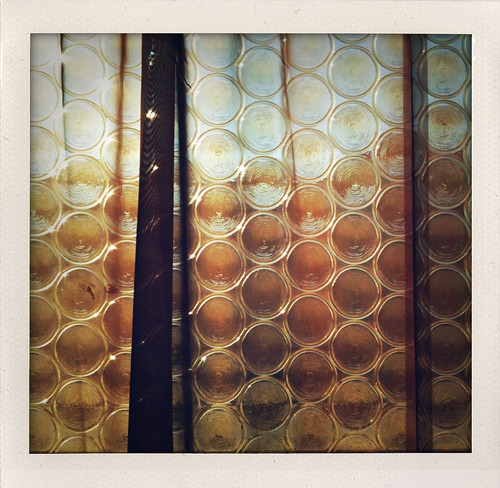
This one taken at an open house down the road which Wendy and I went to view:
Curtains
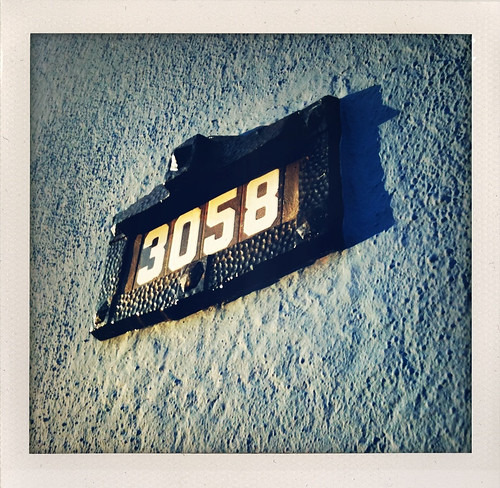
This one round the corner from us in the evening sun:
3058
This one of the Contemporary Jewish Museum downtown:
Museum
This one just up 24th Street from us:
Gate


I just can't help myself!